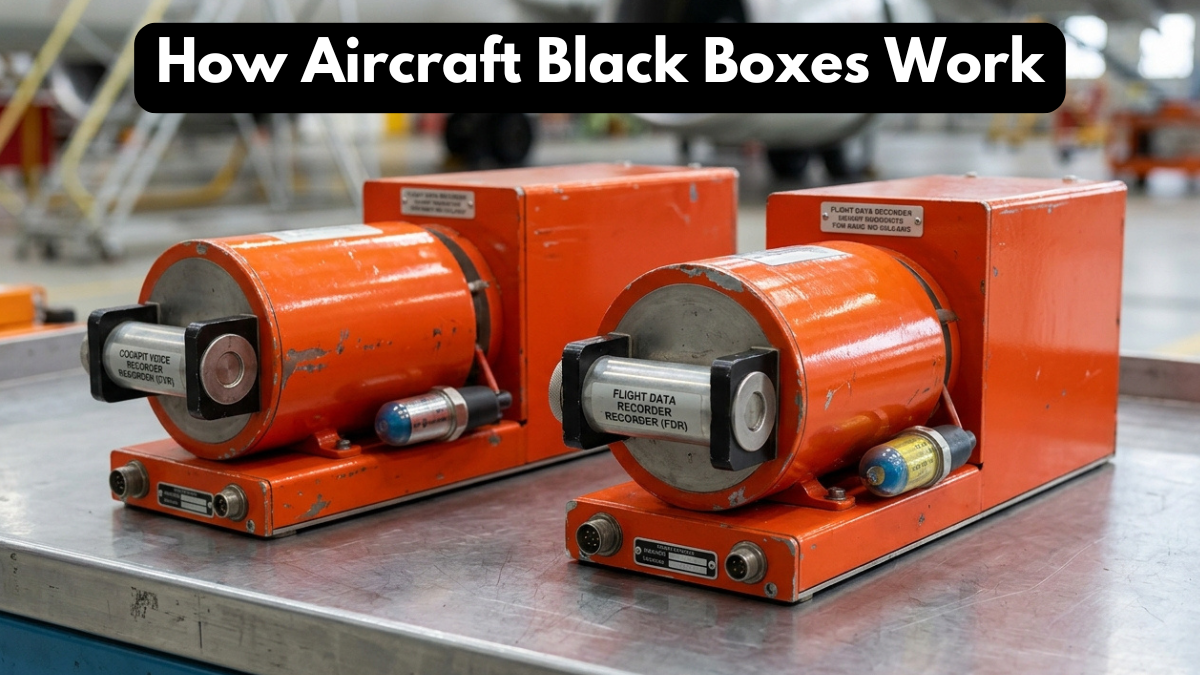
Aircraft accidents are extremely rare, but when they happen, investigators rely heavily on advanced recording systems to understand exactly what occurred. Understanding how aircraft black boxes work reveals the importance of data recording technology in modern aviation investigations. Despite their name, black boxes are usually painted bright orange to make them easier to locate after crashes. These devices are designed to survive extreme conditions such as fire, underwater pressure, explosions, and severe impact forces while preserving critical flight information.
Modern flight recorders are among the most important tools used in accident investigations and global aviation safety programs. They continuously record cockpit conversations, aircraft performance data, navigation information, and system activity throughout every flight. By analyzing this information, investigators can identify mechanical failures, pilot responses, environmental conditions, and operational problems. Learning how aircraft black boxes work helps explain how the aviation industry improves safety standards and prevents future accidents through detailed analysis and technological improvements.
What Aircraft Black Boxes Actually Do
The main purpose behind how aircraft black boxes work is to collect and store information that can later help investigators understand the sequence of events during a flight. Commercial aircraft usually carry two main recording devices: the Flight Data Recorder and the Cockpit Voice Recorder.
Modern flight recorders monitor hundreds of aircraft systems and operational parameters continuously during flight. These devices are built with highly durable materials capable of withstanding severe crashes and harsh environmental conditions.
The two primary black box components include:
- Flight Data Recorder (FDR)
- Cockpit Voice Recorder (CVR)
The Flight Data Recorder stores technical flight information such as altitude, speed, engine performance, control inputs, and navigation data. The Cockpit Voice Recorder captures audio from cockpit microphones, pilot conversations, radio communications, and warning alarms.
Understanding how aircraft black boxes work also requires examining their protective construction. Black boxes are designed using heat-resistant materials, reinforced outer shells, and impact-protected memory units.
Modern aviation safety regulations require aircraft black boxes to meet strict international durability standards to ensure important data survives even severe accidents.
Types of Flight Recorders and Their Functions
Different types of flight recorders perform specific recording tasks during aircraft operations. Modern aircraft often contain highly advanced digital recording systems capable of storing enormous amounts of operational data.
The following table explains major black box components and their purposes:
| Recorder Type | Main Function | Information Recorded |
|---|---|---|
| Flight Data Recorder | Technical flight monitoring | Speed, altitude, engine data |
| Cockpit Voice Recorder | Audio recording | Pilot conversations and alarms |
| Quick Access Recorder | Maintenance analysis | Operational performance data |
| Data Link Recorder | Communication storage | Digital aircraft transmissions |
| Emergency Locator Beacon | Crash location support | Distress signal transmission |
One important aspect of how aircraft black boxes work is data synchronization. Investigators compare voice recordings with technical flight data to reconstruct accident timelines accurately.
Modern flight recorders can store thousands of flight parameters simultaneously. Sensors across the aircraft continuously send information to recording systems during every phase of flight.
Another important feature supporting aviation safety is the underwater locator beacon attached to most black boxes. If an aircraft crashes into water, this beacon emits acoustic signals that help search teams locate the recorder underwater.
How Black Boxes Survive Aircraft Crashes
One of the most fascinating aspects of how aircraft black boxes work is their incredible durability. Aircraft black boxes are engineered specifically to survive conditions that destroy most other aircraft components.
Modern flight recorders are built to withstand:
- Extreme impact forces
- High-temperature fires
- Deep underwater pressure
- Severe vibration
- Chemical exposure
- Structural crushing forces
To improve survivability, black boxes are usually placed near the rear section of the aircraft because this area often experiences less severe impact damage during crashes.
The memory units inside modern flight recorders are heavily protected using shock-resistant materials and insulated metal housings. These protective layers help preserve recorded information even after major structural destruction.
One critical reason how aircraft black boxes work remains so important is because accident investigators rely heavily on recovered data to improve future aviation safety procedures.
Modern black boxes can survive temperatures exceeding 1,000 degrees Celsius for extended periods. They are also tested against underwater pressure equivalent to deep ocean conditions.
Another important feature involves locator beacons. After water impact, black boxes automatically activate underwater acoustic transmitters that help rescue and recovery teams locate them.
The Role of Black Boxes in Aviation Safety Investigations
Modern aviation safety investigations depend heavily on data recovered from aircraft black boxes. Investigators use recorded information to determine what happened before, during, and after an accident.
Important information analyzed during investigations includes:
- Pilot communication
- Engine performance
- Aircraft altitude changes
- Navigation system activity
- Warning system alerts
- Flight control movements
One major reason how aircraft black boxes work is so important is because investigators often cannot rely solely on physical wreckage analysis. Recorded flight data provides detailed insight into aircraft performance moments before an incident occurred.
Modern flight recorders help investigators identify mechanical failures, weather-related issues, pilot decision-making, and communication breakdowns.
In many cases, black box data has directly contributed to major improvements in global aviation safety standards. Manufacturers, airlines, and regulators use investigation findings to improve aircraft design, pilot training, and operational procedures.
Some modern aircraft also use real-time data transmission systems that allow portions of flight information to be transmitted to ground stations during flight. This technology may become more important in future aviation safety systems.
Understanding how aircraft black boxes work demonstrates how data analysis continues strengthening global air travel safety standards.
Technological Advancements in Modern Flight Recorders
Technology continues improving modern flight recorders and expanding their capabilities. Today’s recording systems are far more advanced than earlier analog devices used decades ago.
Modern developments in black box technology include:
- Solid-state digital memory systems
- Cloud-based flight data backup
- Real-time satellite data transmission
- Enhanced underwater locator beacons
- AI-assisted flight analysis
- Extended recording duration
One growing trend in aviation safety involves streaming flight data directly to ground control systems. This could help investigators access critical information more quickly if a black box becomes difficult to recover.
Artificial intelligence is also improving how airlines analyze information collected by flight recorders. AI systems can identify unusual operational patterns and potential maintenance issues before they become dangerous.
Another important innovation related to how aircraft black boxes work involves deployable recorders. Some future systems may eject automatically during emergencies to improve survivability and recovery speed.
Modern aircraft manufacturers are also developing enhanced cockpit recording systems capable of capturing more detailed environmental and operational information.
As aviation technology evolves, black boxes will likely become even more advanced, connected, and integrated into predictive safety systems.
Conclusion
Understanding how aircraft black boxes work reveals the critical role recording technology plays in modern aviation investigations and global aviation safety systems. Through advanced flight recorders, investigators can analyze cockpit conversations, technical performance data, and operational conditions to determine the causes of aircraft incidents.
These highly durable devices have contributed enormously to improving flight safety standards worldwide. As technology continues advancing, future black box systems will likely become more intelligent, more connected, and capable of supporting real-time safety monitoring. The ongoing evolution of flight recorders remains one of the most important factors in maintaining and improving modern aviation safety.
FAQ
What are aircraft black boxes?
Aircraft black boxes are recording devices that store flight data and cockpit audio information used during aviation investigations.
How aircraft black boxes work during flights?
How aircraft black boxes work involves continuously recording technical flight data, cockpit communication, and aircraft system activity throughout the flight.
What information do flight recorders collect?
Modern flight recorders collect speed, altitude, engine performance, navigation data, pilot communication, and warning system activity.
Why are black boxes important for aviation safety?
Black boxes support aviation safety by helping investigators identify accident causes and improve aircraft systems, training, and operational procedures.
Can black boxes survive plane crashes?
Yes, black boxes are specially designed to survive extreme impact forces, fires, underwater pressure, and severe crash conditions.
Why are aircraft black boxes orange instead of black?
Although called black boxes, they are painted bright orange to make them easier to locate during recovery operations after accidents.
Click here to know more.